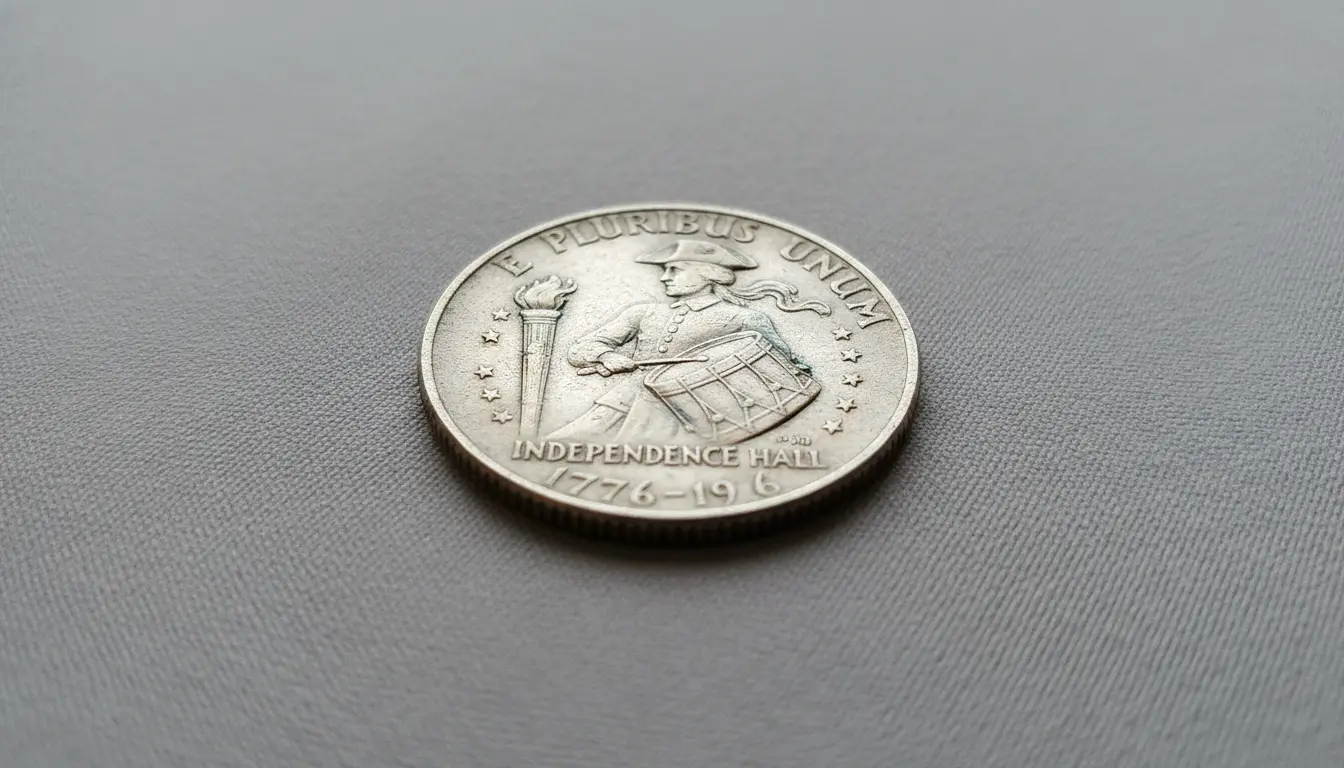
The 1976 Bicentennial quarter is a familiar coin. Most were made for everyday use, but a few varieties are collectible. This article explains what to look for, how rare examples appear, and whether a coin in your pocket could ever reach seven figures.
What is the Bicentennial Quarter?
The Bicentennial quarter was issued to mark the United States Bicentennial with the dual date 1776-1976. The reverse design shows a colonial drummer and was used on quarters produced in 1975 and 1976.
Most Bicentennial quarters are copper-nickel clad and were struck for circulation. Special collector versions were struck in 40 percent silver and issued in mint and proof sets for collectors.
Why some Bicentennial Quarters are rare
Rarity comes from limited minting, special composition, mint errors, and high-grade condition. A common circulation strike is usually worth face value, while a correctly attributed mint error or an immaculate silver proof can be worth much more.
Minting errors and varieties
Errors that can raise value include off-center strikes, doubled dies, clipped planchets, and repunched mint marks. Not all errors are valuable, but dramatic or extreme errors can attract collector interest.
Collector or proof strikes in 40 percent silver are not errors, but they were produced in much smaller numbers and are more desirable than regular clad coins.
Condition and grading
Condition plays a major role in value. Coins graded by recognized services command higher prices. Professional grading gives buyers confidence about authenticity and condition.
Top grades such as Mint State 67 and above for business strikes or Proof 69 and 70 for proofs can add significant value, but those coins remain far more common and affordable than truly rare historic pieces.
Could a Bicentennial Quarter be worth $1 million?
In practical terms, it is extremely unlikely that a Bicentennial quarter would reach $1 million. There are no well-documented sales of a Bicentennial quarter reaching that price.
For a Bicentennial quarter to approach seven figures it would need a combination of exceptional rarity, an unheard-of mint error, and perfect provenance and grading. That combination is very rare for modern commemorative issues produced in large numbers.
Realistic value ranges
- Common circulated Bicentennial quarters: face value to a few dollars.
- Uncirculated or high-grade business strikes: tens to a few hundred dollars.
- 40 percent silver proofs or rare error strikes: hundreds to several thousand dollars in notable cases.
These ranges show why million-dollar outcomes are exceptional and unlikely for this series.
How to examine a Bicentennial Quarter in your pocket
Follow a step-by-step inspection to determine whether your coin is worth more than face value. Use a magnifier and good light.
- Check the date: it should show 1776-1976 on the obverse.
- Examine the edge: standard quarters have a reeded edge; silver collector issues may have the same reeding but different weight.
- Look for mint marks: D for Denver, S for San Francisco, or none for Philadelphia for that year.
- Search for obvious errors: off-center strikes, doubling, and missing devices.
- Note wear and surface quality: sharp details with original luster are more valuable.
If you spot something unusual, stop handling the coin with bare hands. Place it in a soft holder or coin flip and avoid cleaning, which can destroy collectible value.
When to get a coin professionally graded
Professional grading makes sense when the coin appears to be an error, a high-grade uncirculated piece, or a silver proof. Grading can verify authenticity and identify the exact variety.
Reputable grading services include PCGS and NGC. Submission costs are an investment, so confirm the coin has real potential before spending on grading fees.
How to sell a rare Bicentennial Quarter
If confident your coin is valuable, choose a selling channel that matches the coins potential value. Options include specialized coin dealers, online marketplaces, and auction houses.
For high-value or unusual pieces, use a major auction house or an experienced numismatic dealer. They can provide provenance, reach serious collectors, and often yield the best price.
Sale checklist
- Have the coin authenticated and graded.
- Document provenance and any supporting evidence.
- Get multiple price opinions from reputable dealers or auction houses.
- Choose a secure selling platform and understand fees and buyer protections.
Case study
A collector found a Bicentennial quarter in a jar of pocket change that showed an unusual off-center strike. The coin was not cleaned and was placed in a flip and later submitted to a grading service.
The coin was authenticated as an off-center strike with significant misalignment and graded as an interesting error. It sold to a specialist dealer for several hundred dollars, much higher than face value but far from seven figures. The seller learned that provenance, documentation, and careful handling improved the sale outcome.
The Bicentennial quarter uses the dual date 1776-1976 and a drummer reverse. Millions were struck, but silver collector pieces were produced separately and are the more collectible versions.
Final takeaways
A Bicentennial quarter in your pocket could be worth more than face value if it is a silver proof, a high-grade uncirculated example, or a dramatic error. However, a million-dollar coin is extremely unlikely for this series.
Inspect coins carefully, avoid cleaning, and seek professional grading only when a coin shows clear signs of rarity. That approach helps you protect value and make smart selling decisions.